
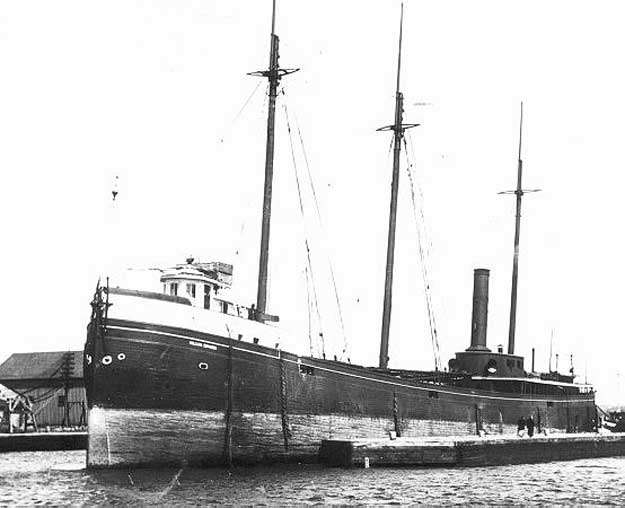
From The Evening Telegram, 19 May 1917, page 6.
S.S. William Edwards
Coal Laden for St. john’s, Foundered off cape Pine – Hair-Breadth Escape of Crew Who Were Rescued by Local Fish Carrier.
Capt. John Dicks, officers and crew of the ill-fated coal carrier William Edwards, which foundered fifteen miles off Cape Pine on Monday morning last, reached the city at 1.30 p.m. yesterday by the Trepassey train. The Telegram interviewed the crew on arrival and learned from them the following facts.
The steamer William Edwards was owned by the William Edwards steamship Co., of Sydney, N.S., and was recently purchased by that company. She was about 36 years old and was formerly engaged as an iron ore carrier on the Great Lakes. She was registered in the United States and was 1,000 tons gross.
The voyage.
Shortly after daylight on Friday, May 11th, having on board 1,535 tons of North Sydney coal, the ship steamed out of Sydney Harbour en route for this port and up till Sunday morning met with favourable weather. Then the wind began to freshen and by four o’clock in the afternoon had increased to a stiff gale which caused the unfortunate ship to labour in the heavy sea. All went well till 7 p.m. when the wind and seas increased with greater violence and one hour afterwards the engineer reported that the ship was leaking badly. A steady stream was then pouring into the engine room, the latter being situated in the aft part of the ship as is often the case in lake boats used for freighting purposes. The emergency pumps were immediately put in action, but despite every effort by the crew to cope with the inrushing waters, hope of saving the ship had to be abandoned, However, it was thought she might possibly keep above water for several hours when the unfortunate crew would be able to make the land in daylight. But at 4 o’clock the following morning (Monday May 14th) something is supposed to have broken loose in the ship’s bottom, thus allowing the water to rush in with greater force. Seeing the ship was to go under in very quick time the captain ordered the whole crew, twenty in number, into a large boat, and lowering the same over the port side, the crew had barely pulled away from her side when the steamer gave a heavy lurch and sank stern first, her bow rising almost perpendicular in the water.
Rescued.
In the teeth of a blinding gale and mountainous seas the shipwrecked crew with but one box of biscuits and five gallons of fresh, water all that could be obtained on leaving the doomed ship, set out to row for the land. After a vain attempt to manipulate the oars in such a boisterous sea they let the boat drift of her own accord. With every stitch of clothes saturated with water and suffering intense cold the prospects of reaching the land before night were not very good, when about 10.30 a.m a sailing vessel was seen in the distance and, as luck had it was coming in their direction. This latter proved to be the schooner Minnie bound for this port. On seeing the signal of distress her skipper bore down on the tiny craft, and about one hour afterwards her precious crew of twenty shipwrecked sailors were taken on board,, where everything possible was done for their comfort. It was decided to land the rescued men at Trepassey which port was not reached till 11 p.m. Tuesday, wind and weather conditions preventing the schooner from approaching the land.
On arrival at the place mentioned the shipwrecked mariners were distributed among the various homes and were kindly treated by the good fisher folks whose hospitality is well known and freely given to those in distress.
Part of crew Newfoundlanders.
Captain John Dicks is a native of Sydney, N.S; 1st mate William Bennett, a former resident of Port aux Basques, but for some years sailed out of Canadian and American ports; 2nd mate Harry Townsend belongs to Louisburg; Chief Engineer Fred Billard is also a native of the latter place. Six of the other members of the crew are Newfoundlanders, all of whom belong to the outports, but were for some time sailing out of Canadian ports. All the belongings of the crew with the exception of the clothes they stood in, went down with the ill-fated ship including the nautical instruments of the captain and first mate. The former estimates his loss at about $500 and the latter about $250.
While leaving the ship one of the stokers got his knee caught between the boat and the ship’s side, straining the muscles so badly that he was unable to walk and on arrival in the city was taken to the general hospital where it is hoped he will soon regain the use of his limb.
